Share




Executive Summary:
Career and Technical Education (CTE) sits at the intersection of two secular trends: the modernization of education and the growing imperative to build workforce-ready talent. Persistent labor shortages, evolving employer needs, and sustained public investment are driving the formalization and expansion of CTE programming and increasing demand for solutions that support the delivery, measurement, and scaling of career-connected learning. For investors, CTE represents an attractive growth market with opportunities across multiple vendor categories positioned to benefit from the ongoing transformation of education and workforce development.
Introduction: CTE’s Role and Resurgence in Secondary Education
For over a century, CTE has occupied a shifting place in US secondary education, reflecting broader economic needs and cultural attitudes toward work, skills, and postsecondary pathways. Originating in the early 20th century with federal investments such as the Smith-Hughes Act of 1917, CTE developed along two parallel tracks: technical programs embedded within comprehensive high schools and traditional academic study, and separate vocational and technical high schools designed to prepare students more directly for skilled trades and industrial employment. Over time, these dual models were alternately expanded and contracted and, in the late 20th century, somewhat marginalized behind the push for “college for all.”
However, the pendulum is swinging back. With frustration surrounding college costs, completion rates, and outcomes mounting, CTE is experiencing a notable resurgence. School systems and policymakers on both sides of the aisle increasingly recognize that universal four-year college enrollment is neither practical nor aligned with student desires and labor market demands. Substantial federal, state, and local investments are fueling program expansion and modernization, signaling a renewed commitment to career preparation as a central mission of secondary education.
Today, over 8.6M US high school students participate in CTE programming, supported by billions of dollars in funding. Critically, the markets for curriculum, software, assessments and credentialing, and supplies that support CTE are evolving rapidly to meet changing workforce and educational demands, creating compelling opportunities for investors.
CTE History in Brief: From the 1917 Smith-Hughes Act to Perkins V
In 1917, Congress enacted the Smith-Hughes Act, establishing the first major federal investment in vocational education. The law provided funding for programs in agriculture, trade and industrial education, and homemaking. Echoing themes that continue today, its supporters argued that a school system focused primarily on college preparation and classical academics did not adequately serve the many students whose interests and career aspirations were centered on skilled trades and technical occupations.
Since its inception, CTE has evolved through several distinct phases of federal support. During its early decades, vocational education expanded through a series of federal initiatives, culminating in the George-Barden Act. Enacted in the aftermath of World War II, the legislation significantly increased federal funding to help meet the workforce demands of a rapidly industrializing economy.
From the 1950s through the 1970s, federal policy broadened the scope of vocational education beyond traditional trades to include emerging technical and science-based fields. During this period, lawmakers also sought to expand access for historically underserved populations, including women, students with disabilities, and racial and ethnic minorities.
A major turning point came with the passage of the Carl D. Perkins Vocational Education Act in 1984. The Perkins legislation and its subsequent reauthorizations modernized vocational education, strengthened accountability requirements, and promoted closer alignment between education and workforce needs. Over time, federal appropriations for CTE programs authorized under Perkins have grown to approximately $1.4B annually.
In the early 2000s, CTE became increasingly integrated into high school graduation pathways and broader school improvement efforts. This trend accelerated with the passage of the Every Student Succeeds Act (ESSA), under which many states incorporated career readiness indicators into their K-12 accountability systems.
Today, CTE is increasingly driven by regional labor market demands and employer partnerships. The 2018 reauthorization of the Strengthening Career and Technical Education for the 21st Century Act (Perkins V) reinforced this direction by requiring comprehensive local needs assessments and stronger alignment between educational programs and workforce priorities. That emphasis on workforce relevance and economic development continues to shape federal CTE policy today.
CTE Today: Millions of Students & Billions of Funding Dollars Seeking Quality Solutions
Secondary CTE is a well-funded space experiencing increasing participation and bipartisan policy support.
Federally, the market is supported by $700M of the total $1.4B in Perkins V funding, with the remainder flowing primarily to colleges and workforce agencies. State contributions are significantly larger: of note, in 2022, Texas provided $3.1B of state funding for secondary CTE, implying roughly $2,600 per CTE-participating high school student. Maine, despite its small population, provided $60M of state funding for secondary CTE, or roughly $8,000 per CTE-participating high school student, underscoring that smaller states can demonstrate meaningful spend intensity. While most of this spending is directed toward labor costs and physical plant, instructional materials and technology are also critical.
Approximately 8.6M students took a CTE course in SY2023-2024, with 3.8M classified as “CTE concentrators” taking two or more CTE courses in a single career pathway. In SY2019-2020—just four years prior—approximately 7.5M students took a CTE course, with 3.0M classified as CTE concentrators. The 16% and 25% growth in CTE participation and concentration, respectively, reflect the strong momentum behind CTE expansion.

Solutions Landscape: Four Key Segments Supporting CTE
The landscape of solutions supporting CTE is fragmented and segments into four practical categories: curriculum, software, assessments and credentialing, and supplies. Although the boundaries between these categories are increasingly fluid, they align with the primary functions schools and districts must support: delivering pathway instruction, facilitating practice and preparation, validating student skills, and outfitting hands-on learning environments.
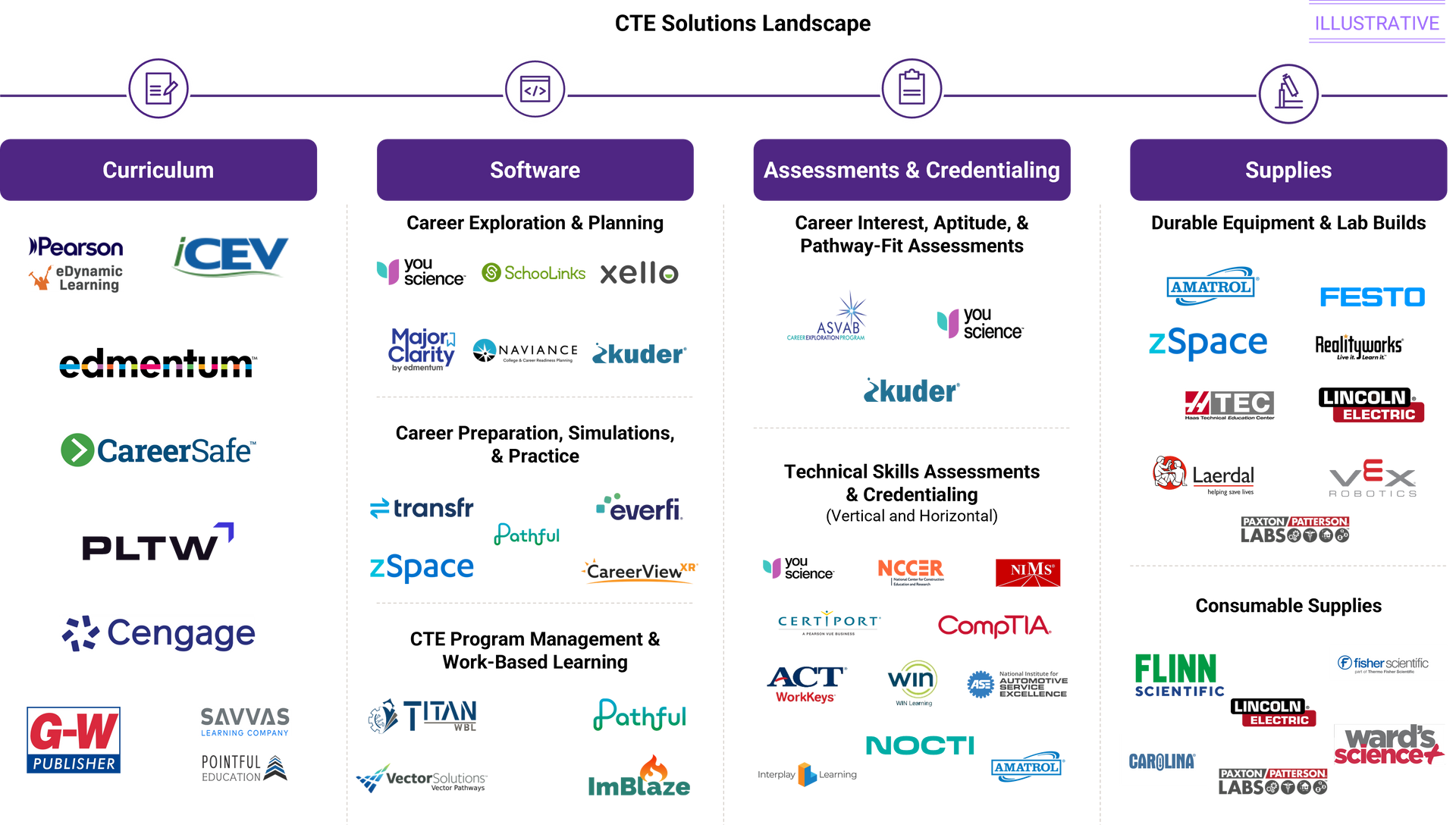
- CTE curriculum vendors provide instructional content and digital courseware that enable the delivery of pathway-aligned programs. While curriculum is foundational to CTE delivery, vendors that offer differentiated, certification-aligned content in high-demand pathways and help districts overcome teacher capacity and facility constraints are seeing the strongest growth.
- CTE software vendors represent a rapidly evolving segment of the landscape, supporting career exploration and planning, technology-enabled practice and training, work-based learning, and overall CTE program management. As CTE becomes increasingly outcomes-driven, the software layer is positioned to become the operating system for the student-to-career journey, connecting student plans, pathway participation, employer engagement, and credential attainment and enabling cross-program administration including tracking, compliance reporting, and analytics.
- CTE assessment and credentialing vendors enable earlier pathway identification and validate technical skills as students progress. CTE’s shift toward measurable outcomes is elevating credentials from a program component into a core value driver, translating student participation into portable, employer-recognized signals of skill.
- CTE supplies vendors provide the physical materials required for hands-on pathways such as healthcare, welding, manufacturing, robotics, automotive, construction, and skilled trades. These vendors fall into two subcategories with distinct purchasing dynamics. Durable equipment and lab build vendors benefit from baseline equipment replacement cycles as well as high-value lab modernization projects, with demand tied to district facilities planning and capital budgets. Consumable supplies vendors represent the recurring spend layer, providing materials that are consumed through experiential learning and hands-on labs and replenished on an ongoing basis.
Investible Themes: Why CTE, and Why Now?
For investors, the central thesis is that CTE is evolving from a collection of elective courses into a large-scale, formalized ecosystem of career pathways. As participation rises, demand is growing for solutions that help schools and districts design, operate, measure, and scale career-connected learning.
Several investible themes currently characterize the CTE space:
Theme 1: Economic and workforce development priorities underpin sustained demand growth
Structural labor market needs and long-term development initiatives, rather than short-term educational trends, are fueling CTE expansion. As states and districts further align secondary education with regional employer priorities, growth in CTE participation and concentration reflects the increasing role of career-connected learning within the high school experience.
Over time, CTE has extended beyond traditional vocational education to encompass high-growth pathways such as cybersecurity, healthcare, engineering, advanced manufacturing, data science, and business. The continued emergence and formalization of new pathways as the broader economy evolves supports continued adoption and spend per student uplift.
Vendors that enable schools to operate and expand pathways, improve program quality, and connect students with industry-recognized credentials and employment opportunities stand to benefit from demand tailwinds.
Theme 2: Durable and diversified funding streams support CTE spending
CTE programs draw from a unique funding environment supported by multiple sources, including federal programs, state allocations, local district budgets, industry partnerships, and philanthropic or grant-based funding. Bipartisan support for career readiness initiatives—rooted in shared workforce development objectives and economic competitiveness goals—sustains public and private CTE investment. This highly resilient funding backdrop supports ongoing spending on CTE solutions, providing vendors with predictable and durable demand.
Theme 3: Multi-product opportunities create attractive revenue profiles
As CTE programs become larger and more complex, districts increasingly seek integrated solutions that can support multiple aspects of the student and program lifecycle. This creates opportunities for CTE vendors to expand offerings across the continuum—from pathway design and instruction through assessment, credentialing, and workforce alignment. Vendors that move beyond a single product category to serve a broader set of CTE workflows can diversify revenue streams, increase share of wallet, and improve retention. Over time, multi-product strategies can contribute to stronger revenue quality, greater customer lifetime value, and more sustainable growth.
Theme 4: Fragmented vendor ecosystem holds consolidation potential
CTE’s vendor ecosystem remains highly fragmented across curriculum, software, assessment, credentialing, and hands-on learning solutions, creating significant opportunities for strategic consolidation. Both within and across solution categories, investors can leverage buy-and-build strategies to assemble complementary offerings into more comprehensive product portfolios and platforms. Successful consolidation strategies can accelerate growth, unlock cross-sell opportunities, improve operating leverage, and support multiple expansion through increased scale and enhanced strategic positioning.
Conclusion
CTE is emerging as an attractive investment arena at the nexus of education and economic development. Structural workforce needs and durable funding streams are catalyzing the growth of outcomes-driven career pathways and increasing demand for solutions that enable the delivery, validation, and scaling of career-connected learning. With resilient and recurring spend, multi-product expansion opportunities, and consolidation potential, CTE offers a compelling landscape for investors seeking exposure to the future of education and workforce development.
To learn more about Grant Thornton Stax and our Education expertise, please visit our Insights page or contact us directly.
Read More