Share



Executive Summary:
Multi-stakeholder models (MSMs) are defined as platforms (marketplaces, Group Purchasing Organizations [GPOs], and professional networks) serving multiple stakeholder groups at once, and they are drawing an increasing amount of investor interest. Grant Thornton Stax believes the most attractive MSMs solve genuine coordination problems in fragmented markets, create measurable ROI for every stakeholder group, and compound those advantages into a defensible flywheel of scale, data, trust, and relationships. As activity accelerates, the differentiator for investors is separating platforms with durable, workflow-embedded value from those vulnerable to disintermediation and technology-enabled alternatives.
Overview of the Multi-Stakeholder Model and What Makes It Attractive
An MSM serves multiple stakeholder groups and generates value for all participants. These models solve coordination problems in fragmented markets by aggregating supply and demand and building trusted networks.
Additionally, their value increases as more stakeholders participate. Members gain access, purchasing leverage, benchmarking data, and vendor discovery; while vendors gain aggregated demand, channel efficiency, and better data. Done well, these platforms become the default destination for buyers, vendors, and professionals in their market.
Examples of utilization across various verticals include:
- GPOs, Purchasing Networks, and Marketplaces: Buyers Edge (foodservice procurement), Premier (healthcare GPO)
- Membership-based Organization/Professional Networks: IFPG (member network to enable franchise growth), Vistage (executive coaching / peer advisory network)
- Events Organizers: Emerald (B2B tradeshow organizer), Easyfairs (European B2B event organizer)
Monetization Optionality with a Clear Quality Hierarchy
MSMs typically combine transaction-linked revenue with recurring data, events, and software across member fees, vendor fees, GPO/purchasing economics, events, software, and data monetization. But revenue quality varies: the highest-quality revenue is recurring, embedded in workflows, and tied to high-ROI use cases. Transaction-linked models scale with member activity and are hard to replicate. Event/sponsorship revenue drives engagement but is more cyclical. Revenue mix is a direct proxy for durability, and a key diligence focus.
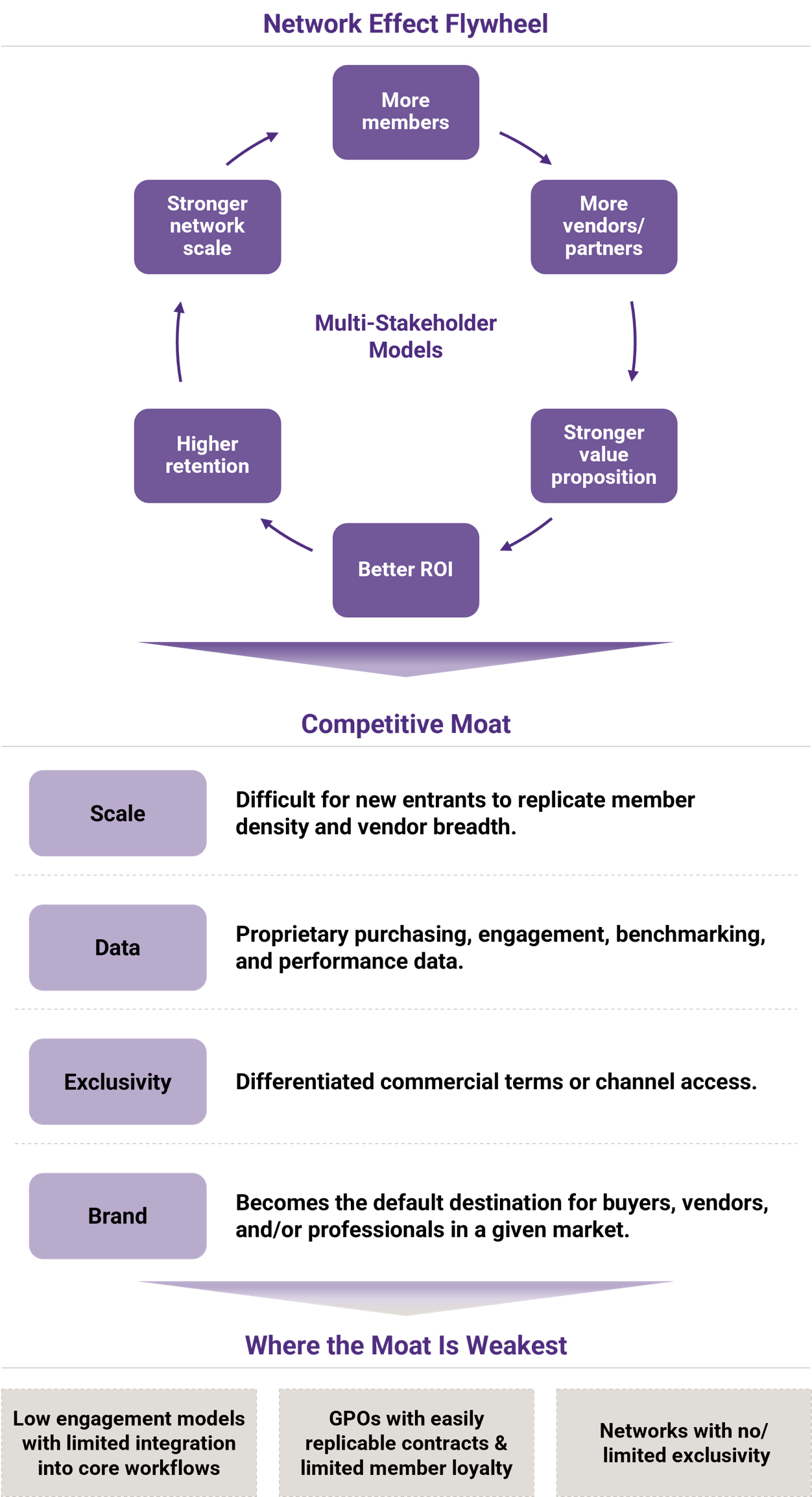
However, for models whose value is primarily introductions or easily replicable matching, AI-enabled tools and B2B marketplaces can reduce the need for the intermediary altogether. The dividing line is whether value comes from coordination and data embedded in workflows (durable) or one-time introductions (disruptable), making a credible AI roadmap a core underwriting question.
Where Private Equity Value Is Being Created
The diligence lens centers on a core test: does the network create measurable ROI for each stakeholder, and can that value scale across members, vendors, and services? The strongest platforms share four traits:
- Multi-sided, quantifiable ROI: Each stakeholder can measure the value it receives (e.g., leads and closed deals for one side, savings and demand visibility for another).
- A compounding flywheel:
Scale, data, and trust reinforce one another into a defensible position rather than a replicable service.
- Recurring, workflow-embedded revenue:
Tied to high-ROI use cases rather than one-off transactions or discretionary spend.
- Clear growth runway: Headroom to deepen penetration, broaden stakeholder coverage, and monetize data, software, and services.
Risks Investors Should Consider
MSMs share a core risk: value depreciation can affect an entire network if participants bypass it, replicate its benefits, or reduce participation when conditions shift. Five warrant explicit diligence:
- Disintermediation (members and vendors connecting directly, or large buyers building in-house).
- Industry consolidation (a shrinking member base with more bargaining power).
- Vendor concentration/churn (vulnerability when few suppliers drive economics).
- Technology disruption (marketplaces and procurement software displacing intermediaries).
- End-market cyclicality (though savings-oriented models can become more valuable in downturns when ROI is clear).
Strategic Implications: Where to Focus, What to Watch
Multi-stakeholder models sit at an attractive intersection of fragmented markets, recurring and diversified revenue, compounding network effects, and multiple growth levers. However, the category rewards selectivity. For investors, several questions should anchor diligence:
- Does the platform create measurable ROI for every stakeholder group or lean on one side?
- Is revenue recurring and embedded in workflows, or dependent on introductions and discretionary spend?
- How defensible is the moat (e.g., scale, data, exclusivity, brand) and where is it weakest?
- Is AI a tailwind that deepens the moat, or a threat that could disintermediate the network?
The question is whether a given platform has built a network whose value compounds, or one that participants can ultimately route around.
To learn more about Grant Thornton Stax, visit our Insights page or contact us directly.
Read More