Share


This article was originally published by ION Analytics (formerly MergerMarket) and was written by Deborah Balshem, Rebecca Wenzel and Akshaya Hari.
Private equity is back in the hospice market though chasing a much smaller pool of assets than during the pandemic-era acquisition boom, according to industry sources.
Lower borrowing costs, aging PE portfolios nearing exit windows, and renewed confidence from large deals have reignited a market that slowed sharply after the 2020-2021 surge, they said.
“The rebound is being driven by both broader market conditions, including lower capital costs and stronger cash positions, as well as hospice-specific tailwinds such as stable reimbursement, a growing aging population, and increasing demand for home-based care,” said Robert Miller, partner at Hooper, Lundy & Bookman.
Andy Voss, home health, home care, and hospice chair at law firm Polsinelli, said many buyers now view hospice as part of a broader care continuum rather than a standalone business.
“Buyers are increasingly focused on disciplined platform-building through add-on acquisitions that create geographic density and integrated post-acute care networks rather than scale alone,” added Anjana Patel, shareholder at law firm Baker Donelson.
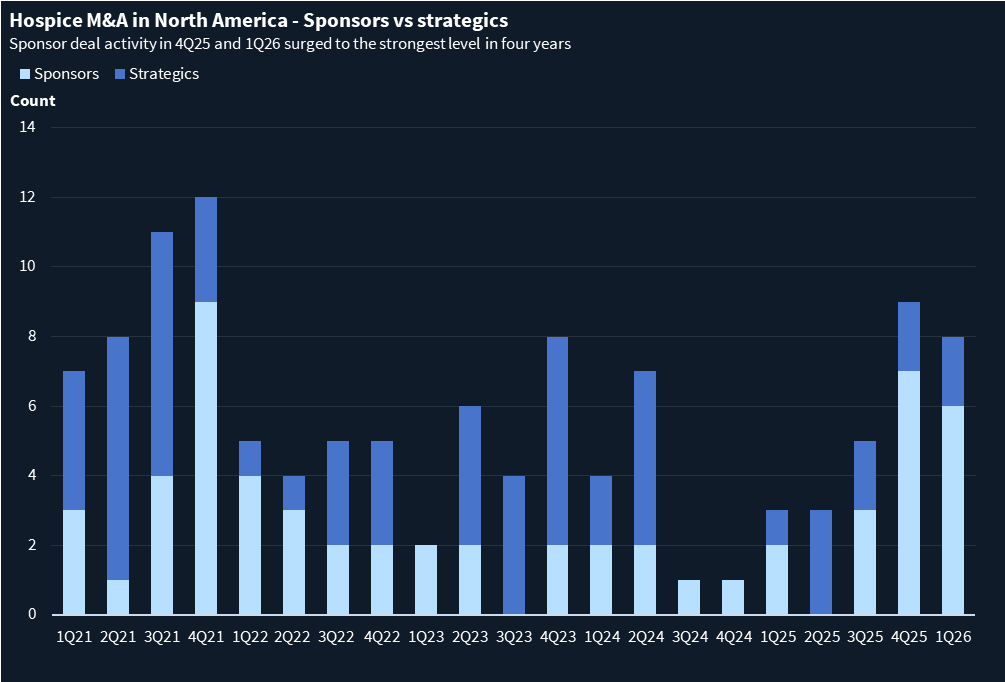
Mergermarket data shows that hospice care M&A in North America peaked in 2020 and 2021, before sinking in 2022-2024 and then rebounding again in the second half of 2025. Deal activity in 4Q25 reached a four-year high, with seven of the nine hospice deals involving financial sponsors. Few hospice deals publicly disclose valuation.
Platform deals revive market confidence
Several sources pointed to large late-2025 transactions as a turning point for the sector.
Cory Mertz, managing partner of healthcare M&A advisory firm Mertz Taggart, said deals including Agape Care Group’s sale to Linden Capital Partners from Ridgemont Equity Partners signaled renewed institutional appetite for larger hospice acquisitions.
“That kind of activity breeds confidence and brings other sellers and buyers off the sidelines,” Mertz said. He added that PE-backed hospice platforms acquired during the 2020-2021 peak are reaching natural exit windows, increasing pressure on sponsors to return capital to limited partners.
One other deal to restore buyer confidence was Bain Capital Double Impact’s acquisition of Legacy Hospice from Prairie Capital last November, according to Rob Larson, managing director of healthcare at Stax, a Grant Thornton company.
Another late-2025 transaction, according to Larson, may signal increasing openness to regional carve-ups as an alternative to traditional single-platform exits: Traditions Health’s break-up sale in December.
Finally, the acquisition of Amedisys by UnitedHealth Group subsidiary Optum – announced in June 2023 and closed in August 2025 – not only reinforced the strategic value of hospice and home-based care assets, but also increasing antitrust scrutiny in the sector, noted Larson. Regulators required UnitedHealth and Amedisys to divest 164 home health and hospice locations across 19 states as a condition of the deal.
Sponsor capital fuels growth
Sources said PE-backed buyers are driving most hospice M&A activity.
“Strategics continue to roll up smaller add-ons, but private equity has been most active across the board, especially new sponsor-backed acquisitions,” said Joe Widmar, director of healthcare transaction advisory at consulting firm West Monroe.
Miller also noted growing interest in joint ventures and other structures that limit financial exposure, while Larson said many deals categorized as strategic transactions are actually funded by sponsor-backed operators.
“The most active buyers by deal count are PE-backed strategics — operating companies with sponsor capital behind them,” Larson said.
Valuations up but buyers are selective
Pricing has rebounded from post-pandemic lows but is more selective than during the 2021 peak, sources said.
Voss said the market has become more quality-driven than growth-driven as buyers focus increasingly on compliance and operational stability.
Mertz said well-positioned hospice platforms are again trading at EBITDA multiples in the high teens.
Hospices with stable referral relationships, growing average daily census, and investments in technology-enabled operations attract most interest, Widmar said.
Strong compliance infrastructure, predictable financial performance, and operational maturity earn higher valuations, added Patel. Yet buyers remain disciplined in diligence, particularly around billing integrity, documentation, and regulatory preparedness, said Miller.
Compliance scrutiny reshapes diligence
Compliance remains the biggest risk in hospice transactions.
Hospice providers face increasing scrutiny from the Centers for Medicare & Medicaid Services (CMS) and the Office of Inspector General tied to eligibility determinations, live discharges, documentation and length-of-stay patterns, sources said.
CMS’s recent six-month nationwide moratorium on new Medicare enrollments for home health and hospice agencies could further shift demand toward established operators by limiting de novo market entry, according to Mertz. He said consolidators have increasingly relied on de novos, particularly in hospice, as a lower-cost expansion strategy, but with that path temporarily closed, demand for compliant providers could increase further.
“Compliance is at the top of the list,” Mertz said. “Any company that looks like it’s been gaming eligibility is going to get heavily discounted or passed on entirely.”
Buyers are increasingly focused on whether hospice census, recertifications and billing documentation can withstand regulatory review, Larson said. Implementation of Medicare’s new HOPE quality reporting requirements and the still-pending Special Focus Program for poor-performing hospices have contributed to longer diligence timelines and more conservative deal structures, he added.
Buyers are also demanding stronger indemnification protections, representations, and pre-closing diligence access as scrutiny intensifies, Patel said.
Voss said prolonged diligence timelines are increasing execution risk by adding pressure on buyers and sellers, while Miller said several high-profile hospice fraud investigations have intensified federal and state oversight. California, for example, has extended its moratorium on new hospice licenses while revising tighter oversight standards.New Paragraph
Consolidation expected to continue
Most sources expect hospice consolidation to continue over the next 12 to 24 months, though not at the pace seen during the pandemic-era peak.
Mertz said aging PE-backed portfolios, ongoing add-on activity, and pressure to monetize investments all point toward sustained transaction volume if financing markets remain stable.
Some of those aging portfolio companies include St. Croix Hospice, acquired by H.I.G. Capital in 2020, and Compassus, acquired by TowerBrook Capital Partners and Ascension in 2019. Others are Three Oaks Hospice, backed since 2019 by a Granite Growth Health Partners-led consortium, and Bristol Hospice, acquired by Webster Equity Partners in 2017.
“I foresee selective acceleration,” Larson said. “More deal flow than the post-2021 downturn, but not a return to the 2020-2021 frenzy.”
Read More