Share



Executive Summary:
The global exhibitions market continued to grow in 2025, but that growth was increasingly concentrated among a smaller group of large and fast-growing organizers. M&A and private equity investment are reshaping the competitive landscape, helping PE-backed and publicly owned organizers expand while institutionally owned players continue to lose share. Looking ahead, strong investor interest, continued consolidation, and growing marketing spend on in-person experiences are expected to support opportunities across the broader events and experiential ecosystem.
Last year’s GT Stax Top 20 traced the exhibition industry’s growth beyond Covid recovery and pointed to a gradual reshaping of its competitive hierarchy. We’ve since seen the continuation of those two trends: sustained double-digit growth for the Top 20 in 2025, and the strengthening of the non-institutional cohort of organizers.
Ranking Changes but No Revolution
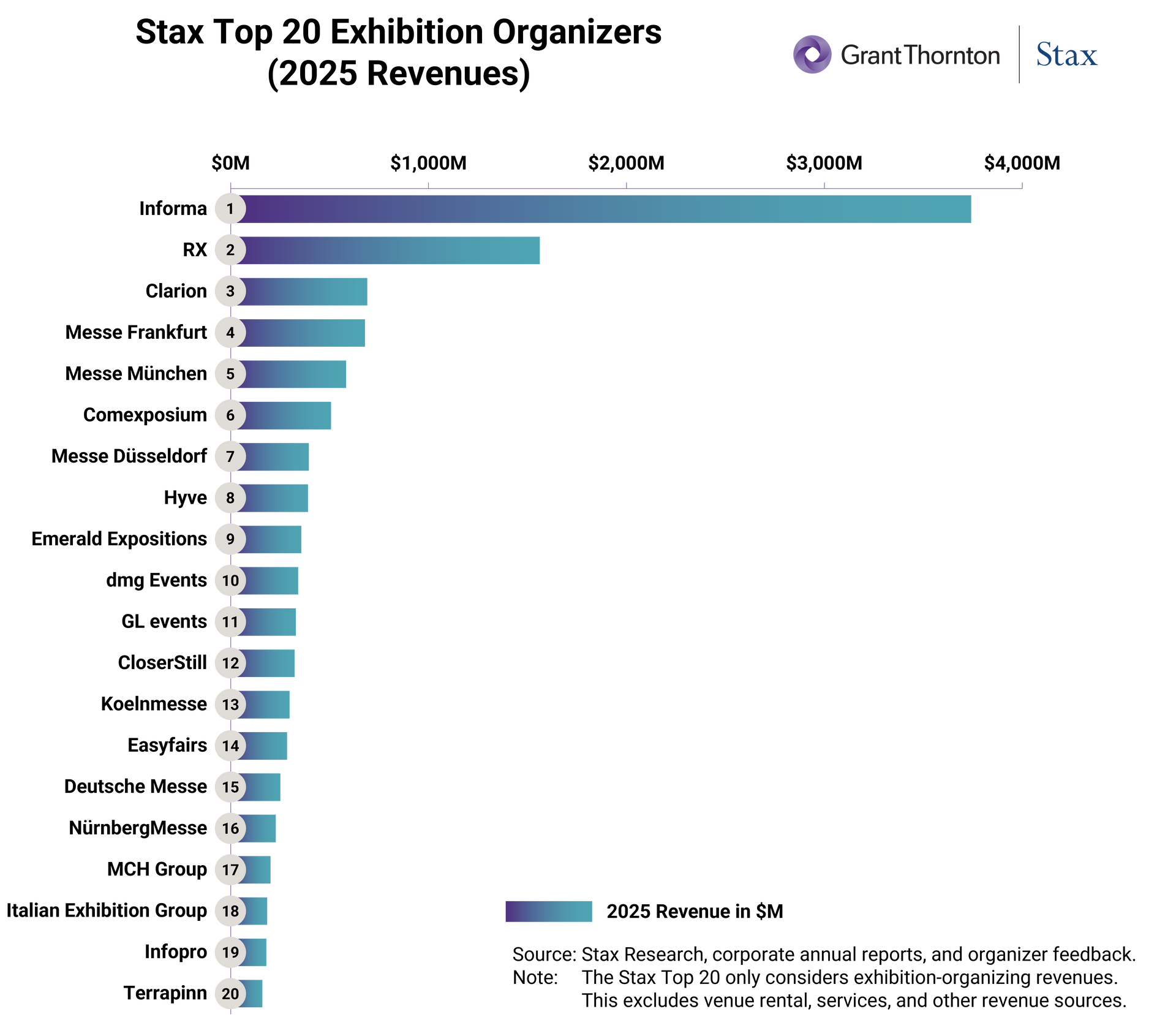
The 2025 snapshot shows that Informa remains the prominent market leader. Informa reached exhibition-organizing revenues of $3.7B and grew over 30%, in large part driven by its acquisition of the Ascential assets. It now represents 32% of Top 20 revenues (up from 27.5% a year earlier) and over twice the size of second-placed RX. In addition, Informa’s revenue growth has outpaced RX and the broader Top20 cohort for the past three years, much of this being acquisition-led.
RX remains the clear number two with revenues of $1.6B, although these were mostly flat in 2025. Completing the podium is Clarion, which regains third place, narrowly jumping ahead of Messe Frankfurt thanks to double-digit organic growth, mostly across its “Superbrands” portfolio.
Messe München (5th) and Comexposium (6th) swap places thanks to Munich’s favorable event calendar (28% YoY growth, helped by the triennial Bauma) and sluggish growth in Paris. Talking of favorable event calendars, GL events made the largest upward move within the cohort, climbing from 15th to 11th following a record year (40% YoY growth, and strong double-digit growth on comparable 2023).
Further down, Infopro Digital enters the rankings at 19th in place of IFEMA, with Terrapinn again completing the Top 20. Infopro is an interesting new entrant as it combines information, software, data, media and events around five industry verticals. Much like Informa and especially RELX, exhibitions are only one part of Infopro Digital’s “media” activity. Continuing organic growth and recent acquisitions have now put the business on the industry radar.
Different Growth Profiles
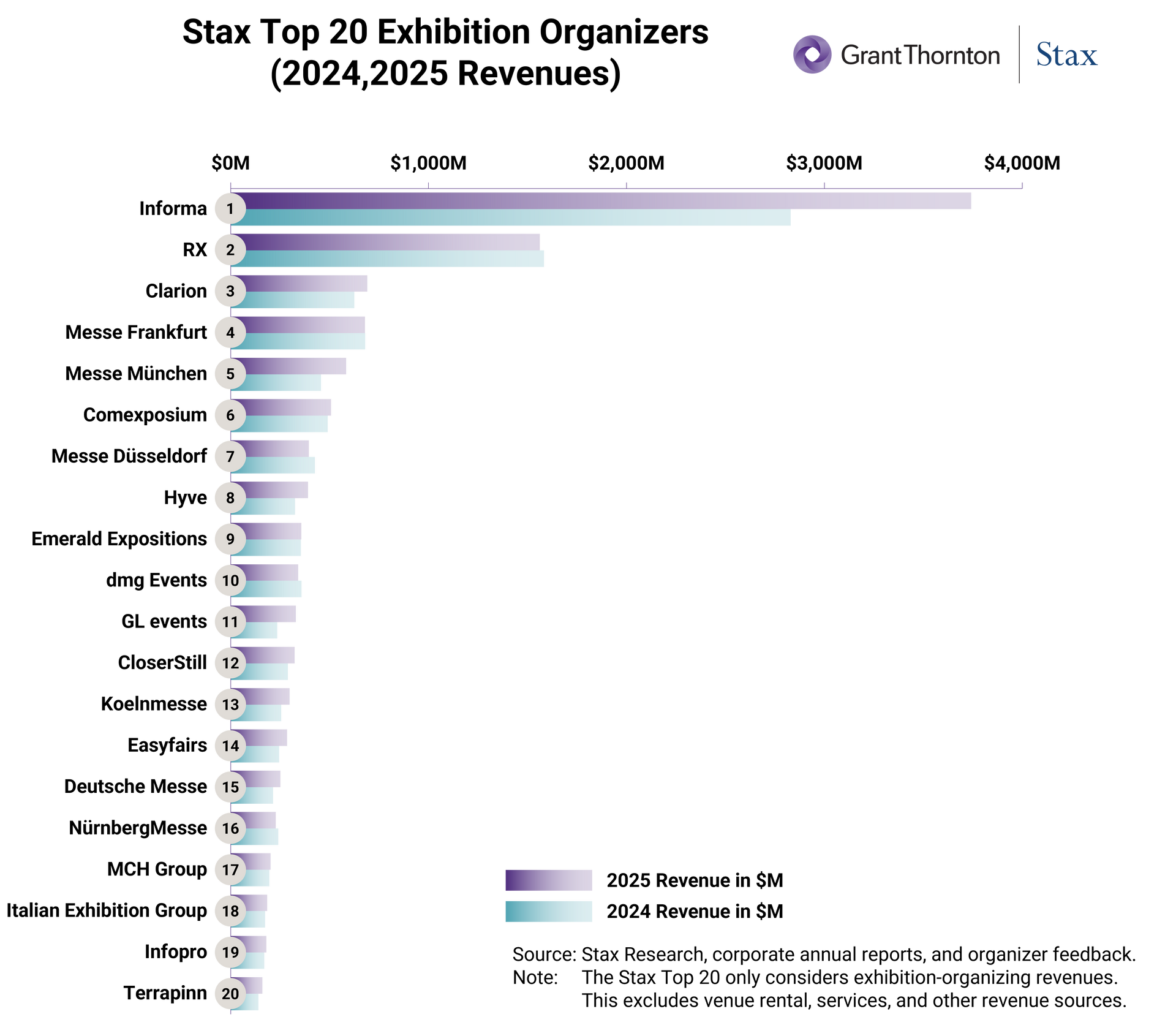
Combined Top 20 exhibition-organizing revenues reached $11.7B in 2025, up ~14% from $10.3B in 2024, at constant 2025 exchange rates. Fifteen of the 20 top international organizers delivered revenue growth.
However, the headline growth figure also masks considerable concentration. Informa contributes 65% of the cohort’s $1.40B revenue increase. Excluding Informa, growth is below 7%: still positive and meaningfully above GDP, but this average hides a bifurcation between a group of ten “double-digit growers” and a smaller cohort of sluggish performers.
Of the five which did not see revenue expansion in 2025, three simply had weaker odd years given their biennial event calendar (particularly Düsseldorf and Nürnberg) but still produced strong double-digit growth on comparable 2023.
Suppressing The Biennial Effect
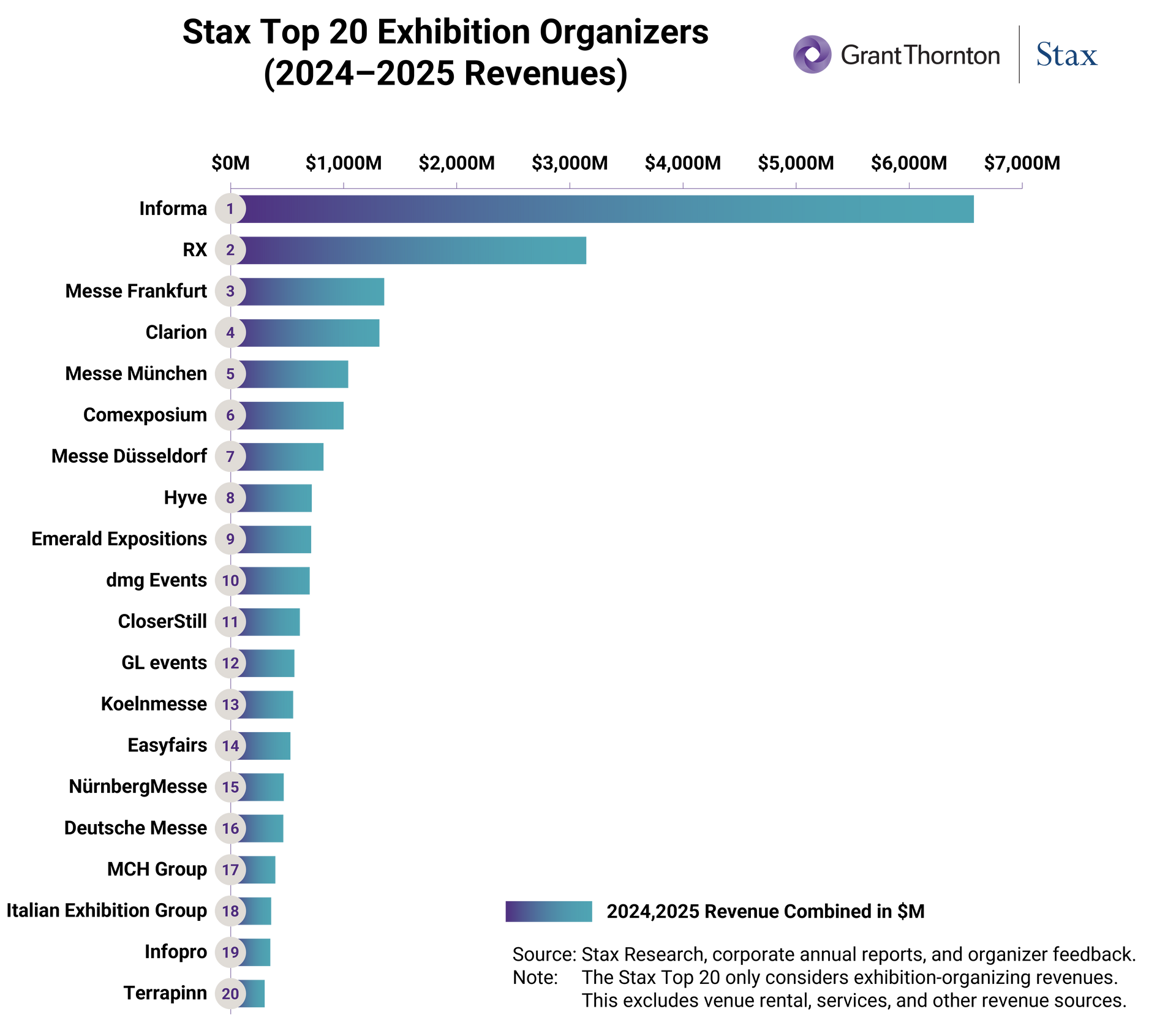
An annual exhibition organizer ranking is partly a ranking of calendars, especially when considering the organizers who typically run large, international capital-goods tradeshows with a biennial or even triennial rhythm. Organizers with major events every other year can move up or down without a corresponding change in competitive strength. Combining 2024 and 2025 revenues, at consistent exchange rates, offers a useful complementary perspective on organizer rankings. But surprisingly without major impact.
Considering 2024 and 2025 revenues jointly, the biggest change concerns those organizers with strong biennial calendars. The two-year view changes three pairwise positions relative to the 2025-only ranking. Messe Frankfurt returns to 3rd on combined revenues of $1.4B, ahead of Clarion’s $1.3B, while NürnbergMesse edges past Deutsche Messe into fifteenth. GL events leaves its 11th place to CloserStill.
The smoothing is somewhat useful as it gives a less calendar-sensitive view of competitive scale, but not complete. Bauma for example runs every three years, so even a two-year window does not fully normalize Messe München’s cycle (and similarly for quadrennial Drupa in Düsseldorf). Acquisitions and event rescheduling can also affect comparisons. Like-for-like comparisons are tricky to make, but they can help identify performance patterns and understand underlying dynamics.
Organizer and Ownership Models
Comparing very different organizers (vertically-integrated vs pure-play organizers vs integrated media; different ownership structures) does require distinguishing between different growth models. To simplify things: institutionally-owned, vertically-integrated organizers mostly grow organically whilst others tend to supplement their organic growth with a meaningful acquisition program (e.g. Informa, Hyve, Easyfairs).
Over the long run, the institutional models have been losing share of Top 20 revenues. In 2015, nine of the Top 20 organizers were institutionally owned, representing 36% of Top 20 revenues. In 2025, only six are left, representing 21% of Top20 revenues. Industry consolidation through M&A has played a strong role in this, driven by the publicly-owned and PE-owned organizers.
It’s interesting to see the continuing push of private equity sponsors in exhibition organizing. The Top 20 2025 now has a record six PE-owned organizers (Clarion, Hyve, Emerald (now Forge), CloserStill and Infopro), when 2024 had five, and 2023 had only four. Private equity investors also own stakes in Comexposium and MCH. With strong PE appetite and ongoing consolidation beyond the Top 20, could this number get bigger?
PE is contributing to reshaping the landscape as it fuels accelerated organic growth (e.g., 11.4% growth in 2025 for the PE-owned organizer cohort vs 7.2% growth for the institutionally-owned cohort). Enabling swift revenue scaling is also a focus of PE owners and this drives industry consolidation via acquisitions. Excluding Clarion which was going through an unsuccessful sale process, all other PE-owned organizers were busy buying event portfolios in 2025. This has continued into 2026 with Hyve, Emerald, Easyfairs, and CloserStill having all acquired meaningful assets, and will further change the ranking as the more aggressive players climb the revenue table.
Looking at 2026: Continuing PE Appetite Across the Spectrum
2026 will likely be the year PE made the biggest splash in the industry, with close to $6B invested across Top 20 players so far. Providence / Searchlight acquired CloserStill, Apollo acquired Emerald and Questex (now combined as Forge), and Hellman & Friedman acquired Hyve.
These big-ticket deals come in addition to the continuing activity of financial sponsors supporting the build of specialist mid-sized players (e.g., Nineteen, Marketplace Events, Techoraco / Institutional Investor or InfraXMedia) and the development of early-stage capital provision (e.g., EVG, Manta Media) to enable the emergence of potential future success stories (and acquisition targets for the Top 20). Investor appetite for businesses in the face-to-face industry is high, and company valuations have risen in 2026. Within the Top 20, there is speculation as to what might happen around Comexposium, Easyfairs or Terrapinn in the coming 12-18 months.
Beyond exhibition organizers, it is interesting to note that the entire ecosystem is benefitting from these positive tailwinds, including general contractors, stand builders, specialist fabricators, AV & lighting suppliers, destination management companies or experiential marketing agencies. PE-driven market consolidation is accelerating as investors look to balance portfolios away from industries suffering from — or at risk of — AI disruption. The broader face-to-face industry is expected to continue benefitting from the growth of marketing budget allocation to in-person activations of all sorts, and financial sponsors are taking note.
For financial sponsors and executives, GT Stax helps understand market and company dynamics, and assess portfolios, business models and growth strategies behind the headline rankings. We support investors and management teams across the entire Events & Experiential ecosystem, globally. To learn more about our Events expertise, visit our Events page or contact us directly.
Read More